Read full transcript
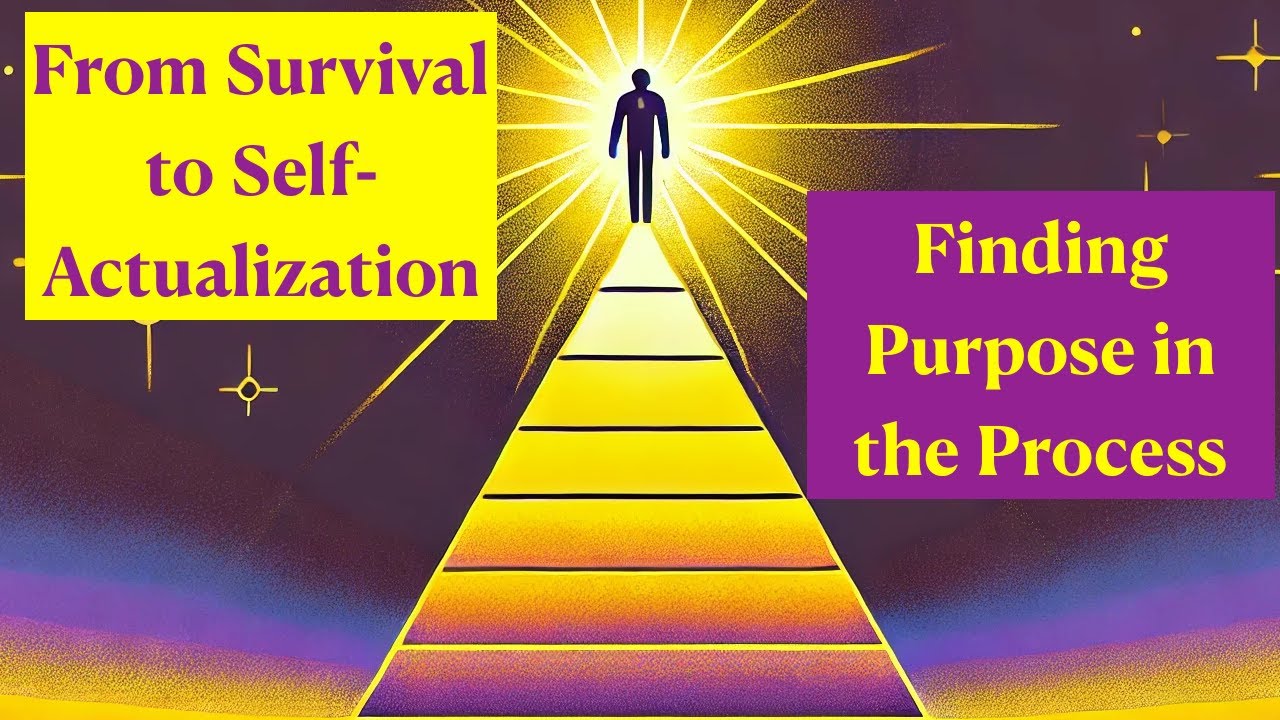
Abraham Maslow famously said, What a man can be, he must be. This concept lies at the heart of his pyramid of needs, where survival is only the beginning. And as we climb higher towards self-actualization, the process itself becomes the goal, a journey of growth, creativity, and purpose. The process, eh? We often hear the phrase law of the process, but how does it play into self-actualization? What does it truly mean?
And why should it matter to us? Welcome to The Meaningful Sh!t Show with your host Vincent. In a world full of selfishness, blaming, and scapegoating, Vincent aims to inspire inner work with deep topics and insights on emotion regulation, personal development, psychology, philosophy, and the trauma growth healing process. Welcome to The Meaningful Sh!t Show. I'm Vincent, your host. In the introduction I talked about Maslow. On the Pyramid of Needs, I talked about loving the process, and this is really what this episode is going to be about.
We're not going to talk much about the base layer of the pyramid, the survival skills. I'm not going to go in that much detail on Maslow's Pyramid of Needs. I assume that it's known by many of you. But to summarize it really quickly, it's a model that a psychologist, that Maslow, created, to give an overview of what our needs as humans are, and that they're built up from a base, which contains the basic survival needs.
Think shelter, food, water, community, safety. And it climbs up to less basic needs, I would say. Like at one point, you have a need for belonging. You can see that it's more important to have a roof over your head, and that once you have a roof over your head, and it's safe, and it's consistent, then you start caring about a community, or you start caring about belonging, that you have connection with some humans around you.
Maybe family comes there as well. They keep climbing, and all the way in the peak of the pyramid, there's something called self-actualization. And self-actualization, contrary to shelter, is not really a goal by itself. It's the process of discovering yourself. And that's different for every human. You would see that it doesn't say in the peak of the pyramid, be a billionaire, or have lots of sex, or any of those things.
That's like the lower level stuff. That doesn't lead to the actual deepest fulfillment. Of course, this is a model. It's different for different people. Of course, there's a lot of thought that went into that. And I think about life in context of that. And I find it really interesting that different problems exist at different levels of the pyramid. What I would say is at the lower level of the pyramid.
I call it sort of the lesser goals. So let's say that in society today, it means in my generation, we are really obsessed with the goals and results. And oftentimes, these are the goals and the results in the base layer of the pyramid. So we chase promotions, degrees, fitness milestones. Like they are the ultimate benchmarks of success. Often overlooking the journey, personal growth, and we're just interested in the medals.
I think it's a very important substation in life to go through. I think that in your 20s, maybe in your teens, in your 20s, you buy into this mindset. You just want stuff, and then you want to be able to buy stuff, or be successful, or sleep with people, or however, whatever is your record, be famous, like these kind of things. So it's a lot about being recognized by the external environment to be a certain thing, or having your skills validated by someone paying you.
And it's important, because as we set these goals and we crush them, we gain more self-confidence. And at first, like I said, the goals are often materialistic. They're pushed to us by family and society. Just graduate with a certain CPA, get a car, finish university, get a job, get a positive performance review, date around, find a good man or woman, move abroad, buy a home in a good neighborhood, have children, get your children into a good school, go on a trip around the world, travel your ass off.
All these things I would say are good, right? However, achieving independence at this stage is crucial because it lays the foundation for making decisions that are truly aligned with your personal values. All these things don't really have to do that much with your personal values. Family, having children, moving abroad, sure. There's flavors in that. It might be much more important to be close to your community. So, yeah, it's sprinkled in there, but by and large, these are just like very generic goals.
So, these are imposed by societal norms or external expectations from parents or your community. If you're in your 20s, do that. Yes, I fully recommend that, to play that game and to be immersed by that. Play the corporate game like it actually means something. Of course, it doesn't really mean something. See my episode about nihilism. Nothing really means something unless you imbibe it with that property. But fall in love with it, with just the chasing of independence, of wealth.
Expose yourself to massive experience so you get to see what you like and what you don't like. Say yes to lots of things. You need to say yes to some things first before you can say no to it. For a lot of it, it's possible that we live our entire life this way. So our goals and the things that we're doing, the way that we spend our time, it's just an endless stream of conventional stuff.
Without exploring what truly matters to you, you as a person, as a unique individual. I would say it's an endless stream of lesser goals. And the reason I call them lesser goals is because they're mundane, they're at the base of the pyramid. Maybe the first, the second, or the third, or something like that, which is important. Like, I don't want to poo poo it, because having a car, a spouse, a dog, kids, a house, a six-figure job is better than just having no responsibilities, being blacked out in a gutter with a needle in your arm.
Yes, it's absolutely better, I would say. It's better from a societal point of view. And for the average person as well. Like, it's better to have these things. But I also think you still didn't get to the most juicy parts of life. And that's hard, because actually to excel in these things, to actually be able to engage in self-actualization, you have to do something pretty radical, which is like, you have to escape the well of gravity of your society and your environment.
Because the average bear does not self-actualize. And as people get older, it starts to happen more. Like, people, as they get into their 50s and 60s, generally achieve a little bit more financial freedom, or they match their expenses and their income or something like that. So they get more time, so they can do more things like spending time with their grandkids and stuff like that. But like all of these things in life, it's kind of a race.
If you spend your 20s, 30s, and 40s doing these base necessities, your time is going to run out to work on the really, truly juicy parts of life, the things that really make life worth living. These base pyramids, they're important. They're important like eating and going to the bathroom and stuff like that. You need them to survive. But there's nothing unique about it. There's nothing inherently fulfilling about that.
What I found interesting about these lesser goals, lower in the pyramid, these goals have an incredible high ROI. And I apologize, I come from a business background. So business bullshit term, return on investment, right? So you invest in something and you get something back. So the focus in a way is on returns. And of course, society is made in such a way that there is incentives that are present, that if you invest in things that are relatively normal and standard, that you will get return on that, right?
If you go to college and you choose a subject or a major that has good job prospects, what society gives you back for your investment is a job with good income. At least that's the promise. That's not automatic, of course, or guaranteed. The lower in the pyramid you are, the more palpable these returns are, and generally how lower the investment is. So based things as having shelter, society provides a lot of mechanisms for you to not be living on the street.
You don't have to have a fancy six-figure income career in order to just have a roof over your head. It might not be fancy, it might not be in a nice neighborhood, it might not be blah, blah, blah, et cetera, et cetera. But society provides in that the same thing of getting clean drinking water to get acceptable food. Like these things, you don't have to invest a ton to get the returns.
And it's not just that the investment is low, it's also made very easy by your environment. Humans are social creatures. So when we're engaging in a process like that, we look at our neighbor. What is our neighbor doing? How can I mimic that? Can I do it something better or smarter or whatever than them? So there's also, this is the gravity well. A gravity well can pull you up as your beginning life or you're struggling to get your survival needs met.
There is a gravity well society that pulls you up. If you're like under the gravity well, I guess the gravity well, you have to visualize in a way, generally gravity pulls you down. In this case, what I'm using as an analogy is a gravity well sort of like in the middle. And if you're under it, it pulls you up, it pulls you up higher. And of course, if you start escaping the gravity well, you get higher than the gravity well, it starts trying to pull you down.
So it's this great normalizer. Think about it that way. Society to a certain extent tries to make the average achievable for most. Some people are still going to be below under the poverty line, etc., etc. And some people are going to be way above, but there is a normalizing effect in society. Not as much as there should be, etc., etc. Let's not get into politics. But that's the idea.
So there's the investment, the work itself. It's the external validation that you get, like your parents rooting you on for doing something like that, or things like health or environmentally conscious so that you know that it's good for you. Just the things that your parents want you to do. But these things are less about what this episode is about because you don't really need to love the process to get some of these things done, I think.
I think the carrot, the reward of having a roof over your head, is high enough to deal with even if your mindset around the process is not good. You might think it sucks to like schlep to whatever job you need to do in order to get your income, to get the roof over your head. But by and large, you'll just do it. You'll get it done even if you don't love the process, even if you're bitching and moaning, and you think that society is unfair and blah, blah, blah.
So from one perspective, the reward is there, and also the stick is pretty big. Like the moment that you don't do it, you're going to end up on the street. You're going to be hungry. And we are surviving creatures, survival creatures. We have billions of years of evolution have guided us into the direction of one point. We start being cold, hungry. All of these lower level processes kick in, and we will start doing whatever is required to get comfortable.
That's what it is to be a human, to be in this body, right? So you don't really need to be that cerebrally skilled to do some of these things. Society helps you, your biology helps you, there's many things that are helping you to do that. What I encountered is that the true interesting things are not these obvious top priorities, right? The things that you do beside your survival priorities, higher on the pyramid.
Now, those are really interesting and hard, because when you get to that level, the gravity well of society actually starts pulling you down. Your friends start pulling you down. What are you doing? Come back to us. Just come hang out and drink at the bar. Why are you going to work out or study or study beyond the studying you've already done? Especially later in life when you've achieved some of these goals, you have your house, your six-figure job, maybe you are conventionally successful, right?
But not fulfilled necessarily because a job is partially fulfilling, but not ultimately fulfilling. These things are the easiest to drop. Think about your health. You can do a ton of expected things that your family and society expect you from it, while ignoring your health, like neglecting your health, really. How many people that you work with are overweight or obese even, or they're abusing substances. Like you can live tens of years, you can live your entire life in an unhealthy way.
Sure, you're going to die a little bit earlier than that, but you can get pretty old these days with modern evidence-based medicine that just gives you a pill to resolve some of these things. It's still going to take time of your life. So these choices profoundly impact overall life satisfaction, influencing your energy levels, your mood, even longevity. These are beyond the basics, basically. For example, taking proper care of your nutrition and your health, that can make such a difference in your energy levels and mood, right?
And if you don't do that, you'll still get through life. Maybe it's a pretty bleak way. You have a pretty bleak perspective on life, and you're depressed then. But generally, you still get your job done. You still get some income. You still are able to punch in, punch out, and then just lie on the couch, depressed, eating Cheetos. You can still get through that. But your creative passions, that's something else.
Engaging with them provides a sense of fulfillment, personal identity, joy, allowing you to explore and express your individuality. For example, painting, writing, or playing a musical instrument can offer a unique way to channel emotions and connect with your inner self, to self-actualize. How many people do you know, though, that wax philosophically about getting in shape or playing their instrument or truly doing what they want, and they postpone it until the next life?
Sometimes you even say that, or, I'll do that in my next life. And they then don't do it because it's easy to not do it. Like if you look around it, it's like if you're not engaging with your passion, it's not that the guy on the street or your friend or your boss is like going to shake you and be like, go chase that down. It's not going to happen because your boss is going to be like, okay, are you performing the way that you're performing?
Okay, good. But I don't give a fuck if you change your passions. I'm not paying you for that. And oftentimes, your friends don't really like that because the less that you're spending on things that are appropriately selfish, the more that they can rely on you. You can drop them off at the airport or things like that. You can be useful for them. You can be useful for your smaller community.
And not useful for the larger circle of concern, right? And not that there's necessarily anything wrong with that. Like, I'm not saying that everybody needs to have a large circle of concern and help the entire world. It doesn't matter. Like, you can very well choose a small community and be intentional in that. That's fine. Like, there's no right and wrong here. Maybe you know someone that says these lofty things but then puts them off.
And maybe that person is looking at you in the mirror every morning. And I want to note again, like, this is not something to be ashamed about. This is how life is designed or structured and how society is structured. You're set up to this. You're set up to be average, to be mediocre. That's what society gives us, which you can have many philosophical conversations about that as well.
It's like comparing that, how that would be in the Amazon, living in the Amazon or something like that. But it's not necessarily a bad thing, right? Because what society also gives us is you can climb higher individualistically than you could do by yourself. Just if you're alone in the Amazon forest, like, I mean, good luck putting together an iPhone or something like that. So you do use the society that creates that averageness.
But the averageness, of course, is going up over time. What was averaged? Like the fact that it's averaged to have a shower. A hundred years ago, a shower, that was not common. I mean, I should fact check that. But where I think of specifically is, I've been to India and visited like sort of the medieval palaces, where you would see what the riches, the sultans, the sheiks, whatever, what kind of luxuries they had.
And even like the toilets that they had. And it's ludicrous compared to what we have now. We average poor person has it better than like a sultan back in the days, from a luxury perspective. I mean, don't take that completely, literally, because of course, it's not that you have all these different servants, but I'm thinking of these creature comforts, like a soft bed, a shower, a refrigerator, all these things.
I think it's fine anyways. I am going to keep going here. So, giving a personal example. So for me, self-actualization, like I am self-actualizing right now. This is me self-actualizing. But is it about being a successful podcaster or actor for that matter? No. No, it's about the continuous creative investment. You know, thinking about this stuff because like, why do I talk about personal development topics? Is it because I think that will make me the most money or that there is the biggest audience for it?
No, it's because I fucking love this shit. It's helped me. It's helped me so much. I owe my life to it in a way. Gosh, I might at one point go more further down in my personal story, but I've had conversations with people that have gone through some of the same things that I went growing up. And he made the remark of like, we are the ones that survive.
Like there are many situations that we can grow up in where people don't live through that. There's hard shit, there's hard psychological shit, there's, you know. So doing this work, engaging in like finding purpose in life, although like you've had hardships, it saves lives is what I think. Of course, you can talk about, is it good that we save lives because we have an overpopulation problem? I know, I know.
You can reflect on all of these things in a black, black pill kind of way and be sarcastic about it. And the fact that that even comes up to me talking about this, knows that I know that way of thinking about things, but that is not the direction of contentment and happiness. So me self-actualizing, thinking, writing, recording about the things that matter to me. It's, it's not about necessarily being successful.
I've talked about my workout routine as well as I come. I've been into working out for a long time now. It's very important for my mental health as well. I've done tons of cardio in the past. I've done marathons, ultras. I've paced people for 100 milers and 100 Ks. Like wonderful stuff. Right now I'm doing a lot of weightlifting, which is not as easy for me. I don't have a typical weightlifter build, I would say, so there's much more challenges about that.
And I'm working with people to do that, which is another form of self-actualization for me. And it's not necessarily about lifting a certain weight, or bench pressing two plates, or squatting three plates, or having six-pack abs, or something like that. It's about the entire process, about understanding my body, respecting what my body can do. Like the moment that you're focusing on doing something like weightlifting or running or something like that, you're much more connected with your body because you're taxing it in a certain way.
You're making it hard for your body. It's like sitting on the couch eating Cheetos is easier, but that doesn't mean it's like better for your body. You need that as well. Let's take my episode about the Polyvagal Theory. You need your rest and digest, and you need your fight and flight. And the more that you push yourself in fight and flight, the better, but you have to be skillful about that.
So anyways, it's not about these goals, right? It's not that if I achieve some of these goals, it's cool to achieve these goals, like a certain body fat percentage or lean muscle mass or like weight, the specific things as in like, like I said, benching two plates or squatting three plates or something like that, or running a marathon, whatever it is. It's not about these things. It's about the continuous pushing, and not pushing in like breaking way, pushing gently, deliberate, challenging is maybe the word that I should have used, challenging my body, getting to know my body better.
And in a way that requires deliberate effort, so not like a rinse and repeat and do the same way, and I just do this thing because I know it's good for me, or something like that. No, you engage with it, believe in it, because it is a value for me. And these things might be completely different things. So generally, because of this self-actualization, it's more like these lofty things that are not essential for your base survival.
I do see, usually for people that are challenged with this, there are things around healthy eating. Why is it hard to eat healthy? Because society gives you so much crap to eat, and it's cheaper and it's easier. How about working out consistently? Why is that hard? Because society brands it in such a way that partially makes it positive, but then makes it really hard as well. And it's uncomfortable to do something that you're not good at, because it's learning.
It's a lot of learning of how your body works. This is one of the things that I love so much about working out, is that as you're specifically weightlifting, it's not just that your muscles grow when you're getting strong, it's your nervous system. So it's partially just your connection, brain-muscle connection being better. So you're growing nervous system, and that by itself can make you stronger, which I'm not a personal trainer.
I work with one because I understand it to a certain level. But I love that. That's fascinating. That's such an exploration of yourself. And it's also very fulfilling to feel these things that, because a lot of the things that you do while working out, while running, while weight lifting, squatting, dead lifting, like these things, they're just simple movement. How can you do these simple movements like over?
And why is it that you can get so much depth in that? And the same goes for yoga, of course. Like, why is that like sort of, why can you do that for 20 years? And after 20 years, you can still be improving your deadlift. You can still be improving your vipassana or like whatever. I was trying to think of a yoga pose on the fly or your child's pose, whatever.
Well, that's not a particularly complicated one. Anyways, getting back on track. So things that I generally see that are hard because of some of the mechanisms that I've spoken about. Healthy eating, working out consistently, cultivating good sleep hygiene, increasing mindfulness, reducing social media or doom-scrolling, approving skin care, stop or reducing drinking, smoking, watching pornography, increasing hours spent outside, not at work or with your kids. So they're all, I don't know, they're not primary goals.
They're not like roof over your head kind of goals, right? Like you can already be a good, highly productive individual and do none of these things, right? You can easily make a six-figure income and ignore all of it, right? You can be unhealthy as fuck and make a lot of money. Those are not at all. In fact, of course, there is some reverse correlation there because with six-figure jobs, sometimes comes the necessity of networking and drinking and these kinds of things, but that's an aside.
Yeah, how many highly functional alcoholics do you know? Or workaholics? And do you see how they get rewarded? Can you see that some addictions don't reward you and put you in a worse position? And can you see that some of the other addictions or compulsive behaviors do reward you and, you know, keep you, they give you money or some kind of different rewards? They might be just as just as bad, but you get a reward from society.
Isn't that correct? So when we're talking about some of these goals, I feel like this is where loving the process comes in, because you're not getting the benefits of riding the wave with your peers. Like some of these normie goals where society, your peers, like whatever, make it easier, make your investment lower, right? Because everybody needs a roof over their heads. So there is a mechanism for that.
And the moment that it becomes really hard, there's social outrage and then blah, blah, blah. Things happen in our society, right? It's also, when you're self-actualizing, you're not getting any easy or high value rewards externally. Intrinsically, yes, but not externally. If you start playing your musical instrument, and painting, podcasting, whatever it is, oftentimes, that's not making you money. Of course, we try to combine these things as much as possible.
But by and large, especially in the beginning, there's no reward for it. In fact, oftentimes, the reverse is the case. People try to discourage you from that. If you are making healthy living choices, and I talk about this in a lot of my episodes, like how does your environment react? If you suddenly start meditating or going to gym or like whatever it is for you, some friends are going to be like, hey, that's great for you.
But there are also going to be lots of friends and colleagues that are like, okay, that's great for you. And you're still going to come drink tonight, right? Or to the game or like whatever, or something that interferes with them. And that can be hard, right? And it's also not for these things that you're helped by, that the process is especially pleasant or easy. Like I mentioned before, for some of the more basic goals, oftentimes the process of achieving it is not necessarily that unpleasant.
It's not made that unpleasant either because it's inherently just kind of like that, or it's made by that in context with your peers and society, because we want people to go through this process, right? Like this. Oftentimes, we see this in society. If the process is too hard, there is outrage and we have to make the process easier. Like we make things easier all the time. Right.
So for your self-actualization goal, no such process optimization process exists, right? Because this is not something that we're not as in society, we're not trying to get all of society to self-actualize. We're trying to get all society to have a roof over their head and eat like blah, blah, blah, these basic things, but we're not trying to get them to the pinnacle. That would be impossible. I put that maybe in a future society where like that well of gravity is so high, that comes with it automatically.
You do see a difference in where in the world you grow up, right? Because you get much more of a chance to do some of the self-actualization in the Western world than if you're living in a poor country in Africa, now note, I haven't lived in a poor country in Africa, so do I know that this is true? But no, this is my Western perspective. It could be completely wrong.
It could be true that in poverty, you're other ways where you can self-actualize just as well, because your survival needs are met quicker. Like, you know, because you can't get a shower and like, whatever, there's no investment, there's no effort that's going into getting that. So you're just living like the way that the rest of the people are living. So I don't know if that necessarily works.
I was trying to question myself there. But I hope that you understand the example that I'm giving, the point that I'm trying to get across. So the three things, to just repeat that, you're not getting benefits of riding the process with your peers, because they're all doing the thing. You're not getting easy or high rewards. You might even get punished. And the process of achieving your goal is not straightforward.
It's not clear. It's not necessarily pleasant by itself without work. So, you need a new tool in your tool belt, a tool that allows you to do the things that are important for you, because right now, there's a lot of things that make it really, really hard for yourself. So, I want to juxtaposition survival and self-actualization again. So, again, the quote from Abraham Maslow, what a man can be, he must be.
So, it's the essence of self-actualization is to drive to reach one's fullest potential. At the base, we have the survival needs like food, safety, and shelter. These are non-negotiable demand that demand attention. However, as these needs are met, the focus shifts upward towards growth, creativity, and purpose. Hallmarks of self-actualization, the transition from survival to self-actualization often require intentional effort to break free from societal expectation and prioritize personal fulfillment.
It's not about abandoning the basics but elevating beyond them to pursue what truly resonates with your values and passion. And this is from Abraham Maslow. So, it gives you a little grist for the meal. It shows you that it's not just my personal anecdotal experience, it is. And there's psychologists that have dedicated their lives work on mapping that. So, let's make it a little bit more personal, personal towards me.
So, how do I love the process for these things? Let's recap what we've covered so far. So, we explored the societal obsession with results, the importance of recognizing personal values, and how focusing on intrinsic motivation can help us stay on track. Now, let's dive into actionable strategies to embrace and enjoy the journey itself. The first step for these things is you're not getting in any time fast.
With all these competing priorities, are you kidding me? They have bigger sticks, bigger carrots. Your bosses wants this from you, your dad wants this for you. No, no, there's not a goal that you're going to achieve any time quick. I think of the quote of Bill Gates again, we overestimate what we can achieve in six months, we underestimate what we can achieve in 10 years. We're talking about 10 year things, right?
This is not a quick thing, like it's not built overnight, whether that's like physical health or skill in a certain instrument or like whatever. Yes, it might take you 10 years. That doesn't mean that you're at zero until you hit year 10 and you're at 100. No, now it's gradual. You tend to grow in, you get stuck on a plateau, but then you have growth spurts. So it's not that you have no product, but it takes a long time, especially with all the competing priorities because life goes on.
Which is why we're focusing on the process itself being the goal in itself. Just walking the path is the goal that we derive, we get pleasure from, we get dopamine from. That's what we're trying to achieve. There is trickery involved, mental gymnastics, where you honestly switch from the goal motivation to process motivation because you believe it to be effective. That is a choice. Believing is a choice.
You might say, but I don't believe it, so screw you. And that's fine. But realize that you can engage with yourself and to see, it's like, okay, where does my non-belief come from? How can I change that belief? It reminds me of a friend of mine that I talk with a lot. He has three steps that he often talks about, which are related to the four noble truths.
I should have researched that, I did not. But the three steps that he often brings into everything he does is, first of all, you have to decide, you have to believe, believe, decide, that the goal is worth it, right? I'll talk about it more. The second is that you have to decide that you're worth the goal, right? A goal can be worthy, but if you think, oh, but I'm just like, you know, Joe Schmoe, I don't really deserve that.
I should just be cleaning toilets at McDonald's. Like, you're not going to get far, right? And then third, you have to believe that there is a process to get to the goal. That doesn't mean that you, I said believe that there is, that you can discover a path. It doesn't mean that you know the path, but you know that you're on a path of discovering the path.
So it doesn't have to be straight shot. It doesn't have to be like straight to Rome. There's going to be detours because you're learning things. And do you want to be effective in learning? Yes, yes, of course, you want to do that in an effective way. But even if you're ineffectively learning, you're still going in the right direction. It doesn't really, it doesn't really mean, but all these three things need to be true.
What I find interesting about that, for all these three points, the moment that you say, oh, but I don't believe it, you're shit out of luck. There's nothing you can do. If you're just like, oh, but I don't believe that this goal is worth it, then it's not worth it. It's very simple. And then it truly isn't worth it for you. And then your job is to figure out what your goal is.
That does seem worthwhile because our self-actualization thing in the peak of the pyramid, it's all different. But you have to discover for yourself, where are you going to put your dollar down? Because watch my episode about nihilism, realism, and absurdism. There is nothing God given to you that says, okay, well, this is the thing that is important. I mean, you can buy into religion and then you can read the Bible and you can see, oh, well, Jesus says that I should feed my neighbor, whatever the shit.
And then you believe that and then you believe that goal and then you do that goal, and then everything is fine. But still you have to believe that. You have to decide that you like the Bible and that you believe what's in it, blah, blah, blah, et cetera, et cetera, right? So it comes down to values, then again, watch my episode about values. So one of the things that we're here, whenever you're in a situation where, and I often do these things that I'm working for myself, there, of course, I have moments of doubt.
Of course, there's moments where I'm like, why am I doing this? Why? What's the point? Why am I putting all this effort? Now, right now, why am I putting all this effort in? I'm sweating, I'm hot, I have this recording stuff set up, I could be doing something else, I could be hanging out with friends, I could be fucking watching the game or some sports ball or whatever.
Why this? Yes, you have to decide that it's worth it, and be okay that there's moments that gets away from you a little bit. So, second step or second point. The core, I think, of loving the process is to program your incentive reward system to create your own carrot and stick. See my episode about the four feel-good chemicals, I want to say. So dopamine is great. Dopamine is getting a lot of backlash these days.
People are going on dopamine fast and stuff like that. It's the stupidest fucking thing I've ever heard. Dopamine is fucking great. Cheap dopamine, you have to be careful with your cheap dopamine. The dopamine that you're getting from hanging out with friends, drinking, watching pornography, shopping, scrolling on social media, I almost forgot. Yes, that reading your email, reading your text, whatever. Yes, yes. Be aware of that. But dopamine has a very important place in your incentive reward system.
What is your incentive reward system? It allows you to do things that are hard because you get little dopamine that gets you to go through with the process. So it's quintessentially required to make the process pleasurable. How do you do that? How do you do something like whatever? I already made the case that this process of doing self-actualization, it's not necessarily per definition unpleasant, but it's hard because no one is doing it.
You're not getting rewarded like all of these different things, right? So how do you do that for yourself so that you reward yourself, so that you generate dopamine, so that you get pleasure from doing this thing that you're doing every single day, instead of like when you've achieved some lofty goal in the future, right? I believe in contrary to what lots of men do, more about that later, is to make the process gentle.
This process itself, doing self-actualization is already fucking hard. The fact that you're doing it is amazing. You don't have to be harder on yourself. There is no point. Not that there is any point to be harder on yourself. I don't believe it to be effective, but like extra, extra here. You have to, I recommend, experiment. So you want to make failure your friend. You're not going to do this first time, right?
When you embark on a journey like this, at first you think that you know everything, and you read the hero's journey, you're gone, like fall flat on your face. Count on it. It's not going to be like this straight road to happiness. Count on failure. Make failure your friend. Plan for it. Expect it. Fail fast. Make sure that it's encouraging sustainably and also gradually, that you make it gradually harder on yourself.
Yeah, I like that. Baby steps. Every time that I discuss a change to my routine or I have a goal or something like that, I talk to my nutritionist or trainer, I'm always surprised about how I am thinking as a classical caveman. I'm making these drastic big changes, right? And they tell me, let's do a couple of little micro tweaks here and there. Just like, you know, and this micro tweaks approach contrasts sharply with the typical or nothing mindset, where we set extreme goals, often leading to burnout or failure.
Sometimes we need extreme goals. If we're blacked out in the gutter and we're keep shooting up with heroin, yes, there are moments where we have to do these extreme things, but not for self-actualization. It's not gonna work, in my opinion. By focus on these small, consistent changes, you create sustainable habits. They're more likely to stick in the long run. Plus, you feed yourself, you create a situation that your incentive reward system is programmed to reward you, because you're doing these little...
You are checking the boxes for the micro tweaks. So instead of making this lofty goal that you then don't meet, so you don't get the dopamine of like checking a box or like feeling good about yourself. Yeah. Let's see. So oftentimes, I mean, this is just an example. When it comes to some of the athletic goals, like what I go through with my nutritionist, oftentimes she just tells me something like, okay, well, reduce your caloric intake by 50 calories per day this week, and then do 100 next week.
Just see how it goes. Where I'm just like, hey, but I read this thing, when Ryan Gosling was shooting Crazy, Stupid, Love, you need like six-pack abs and stuff like that. He lived on fucking broccoli and chicken for six weeks, and he was like, why don't I just go live on broccoli and chicken for six weeks? And, you know, drastic. Well, there's many reasons why that's a stupid fucking idea.
First of all, it's not the healthiest way. It's not sustainable to do that. The second part is like you're comparing apples with oranges or whatever shit. For Ryan, he was working on his acting career. This was a part of the role. This is his primary thing. For you, this is not the primary thing because you have all these other things to take care of. I'm not saying that Ryan Gosling had nothing to take care of.
Of course, I don't know the man. But I hope you get the difference. If you're using the examples of what actors or athletes or something like that are doing, it doesn't always work to Beth. You're not setting yourself up for success. As I said before, especially as men like to make these drastic changes, suffer hard, wake up at 4 a.m. to work out, journal, do nice. But anyways, you're just going to fall off the wagon and do it like a couple of days, maybe a couple of weeks and then you're going to fail.
Instead, you want to do this continuous investment. And I have more tips on making sure that you get your dopamine, one of the subsequent points. But first, the number one effective way is paying, putting your dollar down and working with someone like a community, a program, a trainer, a nutritionist, signing up to something, so you are committed. Because whatever your self-actualization is, there are other people like you that want to work on similar endeavors.
Whether it's painting, sculpting, writing, there are communities for that. The most effective way that I've found for myself is actually paying for things. It's absolutely great to do free stuff, but you're communicating something to yourself if you do something that's free. If you pay for it, well, now it's real, right? And I understand that we're not all in the situation to be able to do that, but there's small ways and large ways to pay for these things.
Although you can team up with people that have similar goals, just like sort of meet up style or something like that, it is not my favorite option, unless your value is to cultivate friendships and you can bond on something like that. It's more about the community than to do that. But because in this situation, you're at the mercy of someone else's motivation. So if you're attaching yourself to someone else, oh, I want to serve every day.
Oh, and you kind of want to serve as well. Okay, let's make a pact. We're both going to serve. And if then that person is saying, well, today, I don't feel like it, or whatever, then you're just like, oh, well, I guess I'm also not going to go. So I don't like that for the reason of self-actualization is a little bit of a solitary journey, I think.
Because it's already very unique that you are considering doing it. But if you have to find people that are also going to be on that, it's going to be hard to find these people and people that do it consistently, not because they're bad people and you're better. It's just because it's hard and everybody has to do it in their same way. Let's see that the person, say the person that you're trying to serve every day with can't make it tomorrow, and then you get demotivated and you don't go tomorrow, but they could make it the day after, but now you're demotivated and you don't want to go surfing anymore.
It's not that one of the two people in this scenario is the slacker or something like that. Also, the goal of surfing every day is, of course, in my opinion, not a good goal. It's the same thing as working out every day. A. It's not achievable. B. It's not the best way to do it anyway. That's beside the point. More about that later. Balancing theory in practice is also important.
I've spoken about that in context of embracing failure. So you at one point just want to let go of theory, just want to experiment. Also work with professionals. Pay for someone to do your programming, if it's something that's related to nutrition, or sports, or something like that, just to get you out of the analysis paralysis mode. Sometimes it can be easy to just work with someone, nutritionist that you like.
Now, they're your guru. They have the gospel, whatever they say, you're going to do for whatever time. Maybe you do that for six months, and then you don't like something that they do, and then you go your own way, or something like that. That's fine. But following someone's dogma can be advantageous, especially if someone went to school for it. You can say, oh yeah, but working out is not complicated.
I can read on the internet how to do it. Sure, you can, but there's a bazillion different ways to work out, or to train for marathons, or whatever. So it can just be handy to choose someone, or a paid program, or something like that, right? I recommend avoiding a mindset of having cheat days. So this is related to the example that I gave of surfing every day as an arbitrary example.
That means if your standard is, I want to surf every day, that means if you don't surf, it's going to be cheat day. I don't feel like I'm saying, whatever. I am much more of a fan of making the plan realistic and making the cheat days in the plan, instead of that you're cheating on the plan and having a cheat day. No, no, make the plan realistic.
Realize that you can do the exact same actions with the cheat day mindset and without it. So consistency is more important than just sheer quantity, right? It's better to work out four times per week and do it well than to work out eight times one week and then zero times the next week. It's obvious. So don't be too ambitious. Be ambitious enough. Also don't just work out once and then never ramp it up.
I'm not saying that working out once is too little. No, it's a great place to start, right? Like it depends on your goals, etc. So there's no too low bar or something like that. Yeah, you have to work with your own personality. Like for me, it happens to be pretty easy to stick to a realistic schedule that I put enough flexibility in, right? So I don't really have to create punishments or like whatever.
If I make a plan, I'm just generally going to follow the plan because I like following a plan. Gets me dopamine because I generally have to plan on like some kind of app. And that means I do it and then I get like a check off an activity and I get a little celebration emoji or something like that. Gets me a little dopamine. That's all required. But I then worked an hour for that dopamine, which is great.
That's how you want dopamine to work. And now I never go to the gym, not wanting to go to the gym or something like that. So I think it's important to give yourself as much grace as possible. So you stick with the program. You want to always want to fuel your in the program. You don't want to fall off the wagon, right? That's it's similar. Look, if you watch my episode on addiction, this mindset of you don't want to be perfect.
You want to focus on harm reduction. And in this case, it's not harm reduction. That's it's actually like going somewhere positive, but it's the same mindset. You want to not fall off the wagon. You just want it to be easy to stay on the wagon, even if it's not ideal. It doesn't have to be perfect. You know, if the perfect thing for where you are and the shape you are is working out six times a week, that would be the ideal.
Who cares if you do it four times a week? Does it mean that you're not going to achieve your goals? Like you probably are. Sometimes there are things like marathon training. You just have to... There are certain table stakes, right? Like you have to run, invest this many hours per week, otherwise you don't get there, depending on your time goals. Right? So it depends. I also recommend keeping...
I already covered this a little bit. It's some kind of visual checklist, where you can track and reward your progress, such as using tools like Trello, Habitica, or even a simple whiteboard or journal. I'm a fan of having things just out there in your living space, so that it hits you all the time, not specifically an app. But apps can be really handy as well. I travel a lot, so then an app can be good.
Journaling also great, just a free form or way of doing it. You still make it easier to celebrate these micro steps and keep the motivation high, keep your expensive dopamine flowing. I recommend in general, but here as well, to committing to an increased mindfulness awareness, meditation, journaling, gratitude practice. As you're solidifying your practices on self-actualization, you're cultivating your expensive dopamine, as I call it, instead of harvesting the cheap dopamine from sources such as shopping, social media, pornography, and substances.
Remember, you can get those instant. You can get that dopamine dip instant. You don't have to do anything for it. And now I'm telling you to make this thing, this program where I have to work out an hour for me to get that dopamine. You're making your dopamine expensive and you're making it valuable. That's good. That's actually a good thing. It's essential to be aware of that and have daily gratitude for that.
Like if you're not aware of that, if you're not seeing that, that is problematic. I recommend affirmations as well. Have you heard public speakers, motivational speakers talking about this is what we do now? Like, I mean, I make a little bit of fun of motivational speakers because they're generally, there are women motivational speakers, but generally the men motivational speakers, they tend to be like really like all far about the 3 a.m.
working up and the best in the world, whatever. And that is true. And maybe that doesn't work for you and that's fine. But I do like the concept of in whatever tone, whatever mindset, whatever you want to like, pretend you're in beast mode or whatever works for you. But to have an affirmation to help you arrest any slipping back into comfort. I find it very useful here.
When as you're because doing self-actualization and oftentimes you're creating new habits. So if you're starting to slip back into an old habit, it can be good to have a couple of affirmations that you like. And as it is with an affirmation, it is best spoken out loud. So that you can tell yourself that you mean. On that topic, I do recommend listening to public speakers. If you need some motivation, so motivational speakers.
I have that in my practices quite a bit when I just need a boost. The great thing about motivational speakers is they generally speak... It's very generic. They're not saying... They're not telling you to do your exact thing, but they're telling you to chase after your goals. They give you a kick in the pants that especially if I think about, okay, I could be scrolling on Instagram right now, feeling bad about what I'm seeing there, because people are doing something better than me, or I'm missing out, or whatever.
Or I could be listening to someone who is giving me the motivation to do things. I get a meta motivation from that because I know that that practice is going to work so much better for me. Just compare watching depressing news versus listening to motivational speakers, and just think what the difference in result would be. For me, it's a no-brainer that the result of someone who is listening to motivational speakers is going to be much more as well.
Thank God for motivational speakers. You can find them everywhere, Spotify, YouTube. You can watch it for free. I also recommend sharing these goals carefully. Show your actions, not your words. Don't tell tall stories that then demotivate you because your ass can't catch the check that your mouth work. Tell people what you've done, not what you're going to do. Tell them when it's done. Do it alone, without your normie friends.
The self-actualization journey is a solitary one. You can find friends that walk that path with you, but I think, in my opinion, my perspective, is that the essence of self-actualization is that it's so personal that it's about you. It's just about you. Does that mean you can get inspiration from people? All these things are possible, but your self-actualization path is your self-actualization path. It's not going to be the same as your body's.
It's not going to be. It's different. It is different. It's unique. It's personal. Maybe this is too much of the American in me. Like, for those of you who don't know, I am originally from the Netherlands, but I've been living in the United States for 10 years now. Of course, what we know about the United States, people are much more individualistic. So whenever I hear myself really ranting about individualism, I'm like, huh, who would I be yelling this from the rooftops if I would have kept living in the Netherlands?
I don't know. But this is the message that you get now from this version of me. Be prepared to do it along. So often these goals change something that's already part of yourself and is accepted, even desired by your environment. So prepare to say no to some things. From a perspective of excitement for working on your goal, first of being bummed out that you can't do your X or Y, like hanging out with friends or something like that.
Be prepared. Cope ahead. If you remember that DBT episode where I talked about... God, I don't know which DBT episode it is, but there is a coping ahead skill in DBT that allows... What that basically tells you is to imagine the situation that you're going to be in in very, very much detail. And then imagine yourself saying no to something that is a hard situation, where just like maybe it's your mother that asks you to do her paperwork, but you really want to be working on this thing.
And then you're going to like break a trend by saying, no, I'm not going to do that. Ask my uncle or something like that. So that can be really advantageous because otherwise you're going to find yourself being like, okay, fine, I'll do it. And if that happens once or twice, that's fine. But one of the things in creating time to work on your own path is breaking with some of these things.
All right. I think that I've covered a lot of important material here. I do want to quickly go back and summarize what I've spoken about, like some of the highlights that I think are the essences of this episode. So what I've talked about is that as you're climbing the pyramid of needs, Maslow's pyramid of needs, you're going to, instead of being accelerated by society's gravity well, you're going to be decelerated by society's gravity well.
By getting a roof over your head, society is going to help you. For self-actualization, society is going to deter you. Society is going to pull you back, oh, now why don't you stop self-actualizing? Just work a little bit more so you can get a bigger car. Society has no specific benefit right now in this stage of history that we're in, to motivate you to do that. So that means that your current mechanisms of getting things done might not suffice.
Suddenly getting these things done is harder. Why? Because you can't follow your peers anymore, because your peers are just doing normie stuff. You're not getting easy, juicy rewards quickly, because it's a very personal journey. There's no one that directly benefits from it from you. So you have to give you the rewards instead of someone else giving you money. And the process is less clear, less pleasurable, less manicured than some of these other processes for goal achievement that you're doing.
For example, if you're going to get a university degree, the process is manicured. And it's like someone else is making sure that it's not too hard, not too easy, like whatever. And because now in this situation, the process is, you know, the three things that I just... And because of that, it is now more important to cultivate, to plan, to create a process for yourself that is that you manicure yourself.
You prepare very carefully. And I've shared a number of different steps on how to do that. And then finally, we went through a number of steps to make manicuring that process that I just talked about for yourself in such a way that you're actually going to achieve it, even though it's harder, even though it's going to take longer, even though, even though, even though. So I hope that this will help you get some of these things done.
Also inspire you to do it in the first place. I think some of the tips I've given, the tips are good, but the mindset behind it, or the vision behind it, is embarking on this journey to begin with. I hope that you can hear in my voice, in my tone of voice, in my body language, how enthused I am about how that is for me and how I hope to inspire others to go through the process of like sifting through their beliefs, sifting through their values, making sure that all the base necessities in their pyramid of needs are addressed and then be able to embark and spend some time doing good self-actualization and how much joy and contentment in life that's going to bring.
All right. So grossly over time, but I hope that this was as enjoyable to you as it was to me. I will catch you next time. This has been Vincent for The Meaningful Sh!t Show.